
Review: My English Persian Kitchen
Glorious piece of theatre that brings the audience together through food and community
A piece of theatre culminating in food cooked and served live on stage to share with an audience is not a typical show.
But food is at the very heart of this gentle performance. The audience – come the end – is invited to become part of the experience and it’s a total joy.
In My English Persian Kitchen, food symbolises bravery, family and community. It’s all based on the true experience of Iranian woman Atoosa Sepehr.
The play is written by Hannah Khalill, who is currently a Writer in Residence at Bristol Old Vic.
My English Persian Kitchen, tells the story of how Atoosa fled a marriage and career in Iran and came to live in London.
She came with very little, other than a passport, which she felt a compulsive need to keep with her at all times.
This is because her Iranian husband had the right to block her passport at any point. It would have left her unable to leave the country and in an incredibly vulnerable position. This was the very thing he attempted to do.
It formed part of her daring journey from Iran to London. A race to the airport driven by her supportive parents to get her out of the country before it was too late. They made it with one hour to go, due to her usually rule abiding mother’s speed driving skills.
The oppressive sense of control by men during this part of the story was prevalent. We felt the tense atmosphere as Atoosa went through departures. Care was taken, never doing anything to draw attention to herself, lest it trigger an intervention by suspicious guards.
She made it. But it was just the first part of a long and difficult journey.
The writing draws parallels with relationships in Wuthering Heights. The book was painstaking translated from English into Farsi by a loving family member.
Despite the coercive control that rears up during the storytelling, Khalill’s writing also challenges our own perception of Iran.
Women, we hear, are statistically more highly educated than men – to graduate level. Women will refuse to cook or say they are unable do to. This is in an attempt to avoid falling into rigid societal expectation from the start.
There are many liberal families in Iran who do not conform to women having less rights than men. Atoosa Sepehr’s own family and father being a case in point. Being a feminist himself, he encouraged and supported independence for both Atoosa and her mother.
Each layer of the story is peeled away like the onions chopped on stage.
Isabella Nefar plays Atoosa. Her culinary skills alone are impressive. But, to keep that going whilst performing storytelling and physical theatre is simply masterful.
She draws the audience into the performance with a quiet sense of determination coupled with that love of food. She tells us her story as if we were her friends.
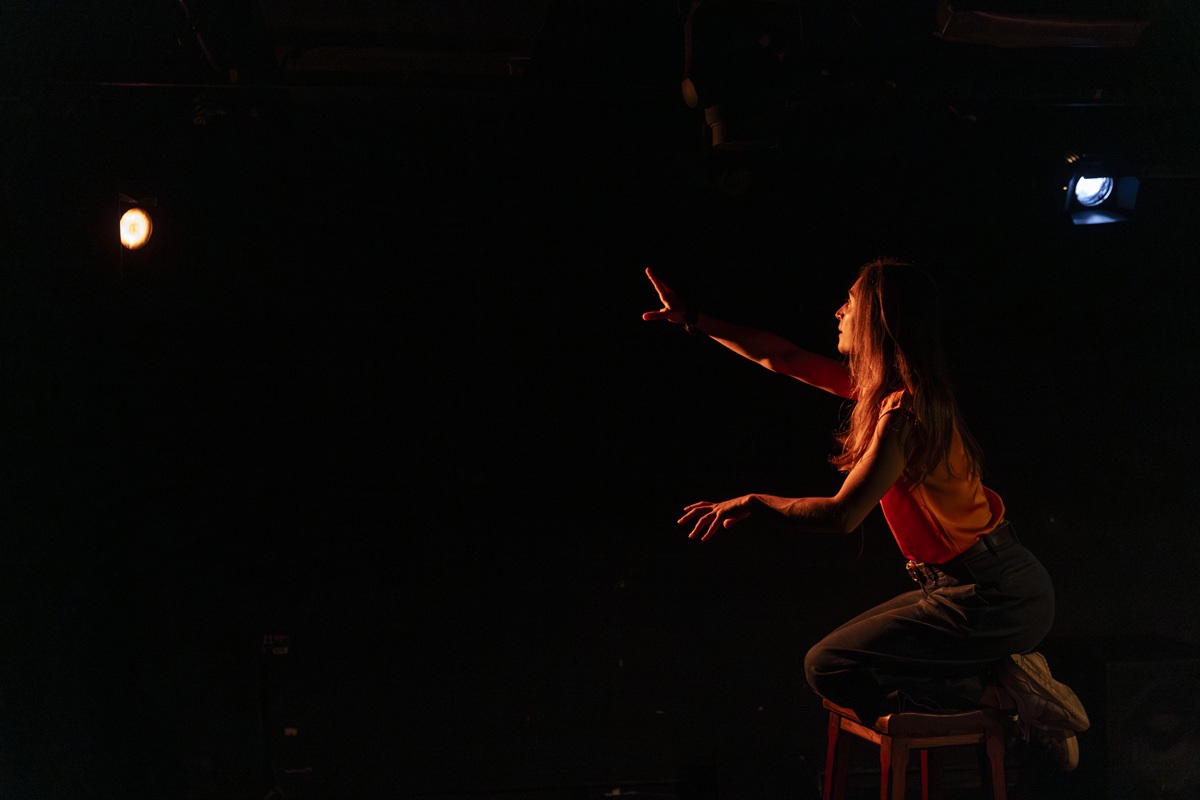
She enthusiastically explores ingredients with us. A shower of turmeric. The smells and the textures of herbs and spices brought to the audience. Dry noodles crack the air, exploding around us. Maths equations are written in the air with a flourish like conductor beating time with oil and water.
Come the end of the show, Atoosa Sepehr’s family photographs are projected onto a huge fridge freezer. The auditorium feels warm and we all feel connected through a sense of community. We are the guests she has been cooking for.



The food theme is important. It’s what helped the Atoosa Sepehr at one of life’s challenigng moments. Moving away from family, food became a way of being with them across the distance. Feeling isolated and alone in London, Atoosa was almost obsessive at recreating every last flavour to authenticity. It made her feel closer to her mother.
Despite the initial polite indifference of Londoners, her neighbours eventually sought out the delicious smells emanating from Atoosa’s flat. It helped her rebuild a community she had lost.
Pip Terry’s set design and costume in warm colour palettes made us feel welcomed. It created a friendly atmosphere, blending perfectly with natural fresh ingredients, the spices and the smell of cooking.
Moments of menace were enhanced by Dan Balfour’s sound design. Marty Langthorne’s intimate lighting around the kitchen island kept us focused on the moment.
My English Persian Kitchen is such an uplifting show. With the final communal sharing of food, we are yet another community that Atoosa has brought together through her love of family, food and community.
My English Persian Kitchen is in the Weston Studio of Bristol Old Vic 14 – 18 October 2025
For more information or to book, visit: https://bristololdvic.org.uk/whats-on/my-english-persian-kitchen
Cast and Creatives
Starring Isabella Nefar
Playwright: Hannah Khalil
Original Story: Atoosa Sepehr
Director: Chris White
Set Design and Costume: Pip Terry
Lighting: Marty Langthorne
Sound: Dan Balfour
Movement Direction: Jess Tucker Boyd
Photography: Production photos taken by Ellie Kurttz on the 26 July 2024 at the Soho Theatre
Home: https://backstagebristol.com/
Bluesky: https://bsky.app/profile/chopsybristol.bsky.social
TikTok: www.tiktok.com/@chopsybristoltt
Facebook: https://www.facebook.com/backstagebristol
YouTube: https://www.youtube.com/user/chopsybaby