Review: The Ocean Can Be A Bridge – Alma Tavern Theatre
An outstanding piece of theatre that gives us plenty to think about.
“Superb!” “Outstanding!”
The words emanating from the row behind following the bows must surely echo the universal audience thought.
The Ocean Can Be A Bridge was outstanding and it was superb. In fact, it is one of those pieces of theatre that so neatly packs in a myriad of complex themes – this one of a fundamentally important moment in Black history – that a second watch would be well worth it.
It’s not a historical play. Though set in 1846 and historically accurate in its writing and staging, its heart lies in resistance – what that means for those personally affected and those carrying it out.
To do and say nothing is to be complicit, but to talk over people is one of the major themes.
The play is written by writer and academic Richard Bradbury and diversity consultant and Caribbean heritage champion Dave Samuels. It’s staged through Riversmeet Productions.
Dave Samuels is originally from Bristol. His father Norman Samuels was the city’s first Black bus driver, an application he made as part of his action towards the Bristol Bus Boycott.
Frederick Douglass, born into slavery in 1818, liberated himself in 1838 and went on to become the most reknown abolitionist in history. The story of his life is exceptional. The man himself wrote three different autobiographies, each covering a different era of his life.
The Ocean Can Be A Bridge finds Frederick in 1846 on a tour of the UK. With his powerful oratory skills, he has been campaigning for the abolition of slavery.
He really did come to Exeter and his speech drew some of the largest crowds the city had ever seen.
During his UK tour, slavery had been abolished in the UK with the The Slavery Abolition Act 1833 coming into force in 1834. But having escaped slavery in the US he was unable to return home. Slavery was not officially abolished there until until 1865.
The Slavery Abolition Act 1833 made sure that slave owners were paid for the financial loss of their slaves. The final compensatory loan repayments didn’t end until 2015.
Through the supporting characters of abolitionist and social reformer William Lloyd Garrison and abolitionist ally Reverend Francis Bishop – as well as Mrs Sercombe and Sister Patience Leigh, the different stances of each show that allies are powerful, but they will never fully understand the lived experience of racism.
The writing explores unconscious bias.
The aspects of slavery that always come up in social media news comments – the “yeah but what about this…” – like it’s some kind of gotcha.
Conversations play out between characters that you’ve seen in heated binary Twitter discourse.
The white privilege showing when deeply offensively personal questions are asked without a care.
There’s the arguments between direct action and a tamer approach – all whilst Frederick Douglass is there and whose own wishes are largely being ignored.
There’s the comparison made between slavery and other forms of discrimination by white characters. But as Douglass points out, they are not in danger of being sold off.
The writers really have covered everything.
The play, although relevant for all time, finds itself on stage in Bristol at a point where the far right has swelled in numbers.
Despite Bristol’s reputation for protest and social justice, the dumping of slave trader Edward Colston’s statue in the docks, the city is not immune to racism, bigotry and Xenophobia.
Some of Bristol’s biggest institutions were founded and funded by the transatlantic slave trade and we are still not even close to equity in the city.
Where racists were once afraid to speak out, they are now empowered. Cheap ragged England flags flap around poles about like dead bats in the wind. Bristolians come out in numbers when needed to line up outside of places where refugees are housed and supported to stop them being targeted with organised hate.
This play is absolutely one of the most relevant things you can see on stage right now. The historical context is also important. It’s a story of a shared history for Black communities and a warning for well-meaning white people that they won’t ever fully understand the experience of being Black so they need to stop and listen.
In The Ocean Can Be A Bridge, Frederick Douglass finds himself pulled in many directions by the well-meaning. In some ways, it is like he is a commodity once again. He’s a puppet. Despite being a free man, the white saviour is in the room with us, trying to manage his life in ways he does not wish.
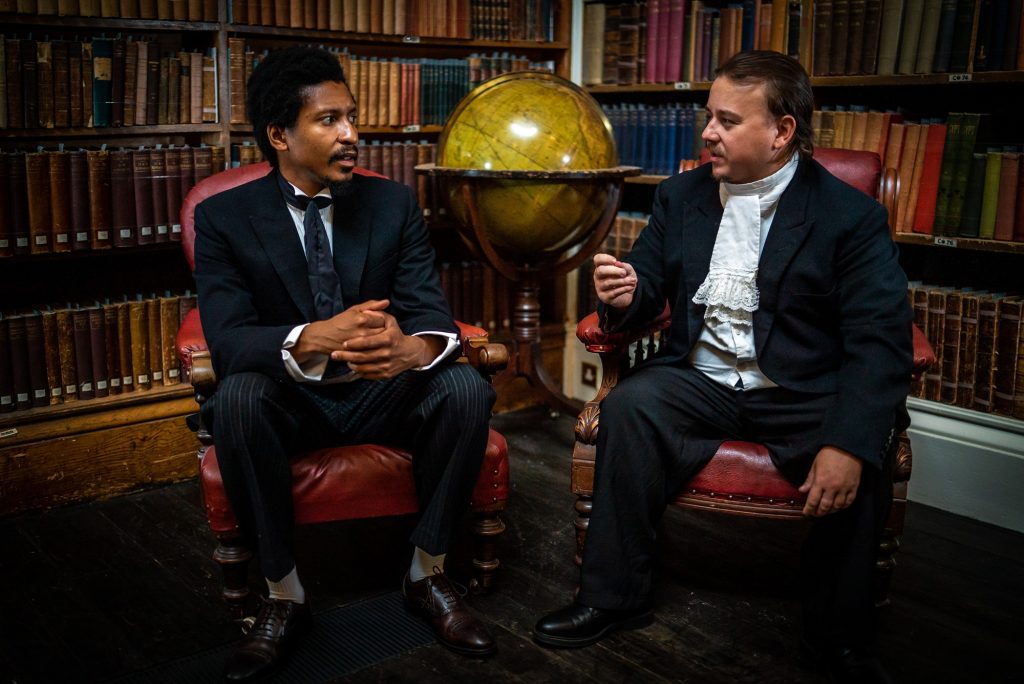
Brandon Benoit-Joyce is Frederick Douglass. His performance is magnificent. He has a magnetic stage presence that makes us buy into what he’s saying. A brilliant choice for the world-famous orator.
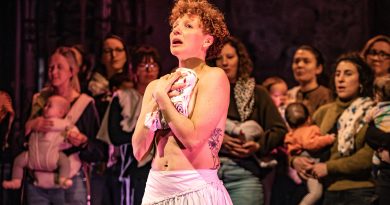
Maureen Casey gives us the perfectly cringe-worthy performance as Ellen Richardson, creating an uncomfortable atmosphere. We are all silently willing her to stop talking – in the best way possible.
Tanya Nelson is Sister Patience Leigh. She favours the more direct action. She feels comfortably in the representation of the Bristol left, unable to ignore an injustice and so has all the roads in the centre blocked by dinner time.
Aidan Casey’s performance was impressive, perfectly nailing the speech patterns and mannerisms of an upper middle class reverend.
Casey also directs. The blocking was excellent, making clever use of curtains to show Douglass’ entrance and exit onto the stage for his speeches.
This was enhanced by Marcos Willatts’ beautiful lighting. It pulled focus towards Douglass, capturing a sense of isolation and inner turmoil.
The Ocean Can Be A Bridge is a well-written, well-acted and a compelling piece of theatre. It centres the Black voice and life experience of Frederick Douglass. It entertains, informs and gives us plenty to think about.
Standing up and saying “no, this is wrong and must stop” is one of the most important things we can do. But as genuine allies who listen, leave egos outside and centre the voices of those impacted by the injustices experienced within that community.
The Ocean Can Be A Bridge will be at the Alma Tavern Theatre until 10 October 2026
For more information or to book, visit: https://www.tickettailor.com/events/almatheatrecompany/2271077
You can follow Riversmeet Productions on Instagram: https://www.instagram.com/riversmeetproductionsuk/
Cast and Creatives
Frederick Douglass – Brandon Benoit-Joyce
William Lloyd Garrison/Henry Richardson – Richard Pulman
Mrs Sercombe/Ellen Richardson – Maureen Casey
Sister Patience Leigh – Tanya Nelson
Rev Francis Bishop – Aiden Casey
Producer – Maureen Casey
Sound and Lighting Design – Marcos Willatts
Poster Design – Sereena Knapp
Programme Design – Paula Serra Santos
Photography – Benjamin Akira Tallamy
For What’s On In Bristol:https://backstagebristol.com/
Bristol Culture: www.tiktok.com/@chopsybristoltt
Bristol Theatre Updates: https://www.facebook.com/backstagebristol
Bristol Theatre Updates:https://www.threads.com/@backstagebristol
Bristol News and Culture: https://www.youtube.com/user/chopsy